Jay-Z

Shawn Corey Carter (born December 4, 1969) known professionally as Jay-Z (stylized as JAY-Z), is an American rapper, entrepreneur, songwriter, and record producer. He is one of the most acclaimed rappers of all time.

Born and raised in New York City, Jay-Z began his musical career in the mid 1990s, after which he released his debut studio album, Reasonable Doubt, in 1996, to widespread critical and commercial success. He released the album a year after founding the record label Roc-A-Fella Records. His subsequent albums have also seen great praise, with The Blueprint (2001) and The Black Album (2003) later being heralded as modern musical classics. He followed these with the collaborative album Watch the Throne (2011) with Kanye West, his critically lauded thirteenth studio album 4:44 (2017), and a collaborative effort titled Everything Is Love with wife Beyoncé in 2018.

Jay-Z’s business activities and life outside of music has also received significant mainstream attention. He is the owner of 40/40 Club sports bar, and co-creator of the Rocawear clothing line. He has also acted as the president of Def Jam Recordings, and is the founder of the Roc Nation entertainment company, as well as creating its spin-off, Roc Nation Sports. As a member of Roc Nation Sports, Jay-Z is a licensed sports agent. His heavily publicized marriage to singer Beyoncé in 2008 has made him a global figure in popular culture. As a couple, they have an estimated combined net worth of $1.16 billion, with his individual net worth of $900 million making him the richest hip hop artist in the world.

Jay-Z is one of the world’s best-selling music artists. He has received 21 Grammy Awards, tied with Kanye West for the most by a rapper.He also holds the record for the most number-one albums by a solo artist on the Billboard 200, and has recorded four number-one singles on the Billboard Hot 100. The same publication ranked him as the biggest artist of the 2000s, while Rolling Stone named him one of the 100 greatest artists of all time. He is the first rapper to be honored at the Songwriters Hall of Fame in 2017 and to receive the “Salute to Industry Icons Award” at the 60th Grammy Awards.

Carter was born in the Brooklyn borough of New York City and was raised in Marcy Houses, a housing project in the Bedford-Stuyvesant neighborhood. After their father, Adnis Reeves, abandoned the family, Shawn and his three siblings were raised by their mother, Gloria Carter. Reeves would later meet and reconcile with Jay-Z before dying in 2003. Jay-Z claims in his lyrics that in 1982 at age 12, he shot his older brother in the shoulder for stealing his jewelry. Along with future rapper AZ, Carter attended Eli Whitney High School in Brooklyn until it was closed down. He then attended the nearby George Westinghouse Career and Technical Education High School with future rappers The Notorious B.I.G. and Busta Rhymes, followed by a stint at Trenton Central High School in Trenton, New Jersey, though he did not graduate. According to his interviews and lyrics, during this period he sold crack cocaine and was shot at three times.

According to his mother, Carter used to wake up his siblings at night banging out drum patterns on the kitchen table. She bought him a boom box for his birthday, sparking his interest in music. He began freestyling and writing lyrics. Known as “Jazzy” around the neighborhood, Carter later adopted the showbiz/stage name “Jay-Z” in homage to his mentor Jaz-O.

Jay-Z can be briefly heard on several of Jaz-O’s early recordings in the late 1980s and early 1990s, including “The Originators” and “Hawaiian Sophie.” Jay-Z became embroiled in several battles with rapper LL Cool J in the early 1990s. He first became known to a wide audience on the posse cut “Show and Prove” on the 1994 Big Daddy Kane album Daddy’s Home. Jay-Z has been referred to as Big Daddy Kane’s hype man during this period, although Kane explains that he didn’t fill the traditional hype man role, and was instead “basically ma[king] cameo appearances on stage. When I would leave the stage to go change outfits, I would bring out Jay-Z and Positive K and let them freestyle until I came back to the stage.” The young Jay-Z appeared on a popular song by Big L, “Da Graveyard”, and on Mic Geronimo’s “Time to Build”, which also featured early appearances by DMX and Ja Rule in 1995. His first official rap single was called “In My Lifetime”, for which he released a music video. An unreleased music video was also produced for the B-side “I Can’t Get with That.”

Written by Dianne Washington

Tyra Banks

Tyra Lynne Banks (born December 4, 1973) is an American television personality, producer, businesswoman, actress, author, former model and occasional singer. Born in Inglewood, California, she began her career as a model at age 15, and was the first African American woman to be featured on the covers of GQ and the Sports Illustrated Swimsuit Issue, on which she appeared twice. She was a Victoria’s Secret Angel from 1997 to 2005. By the early 2000s, Banks was one of the world’s top-earning models.

Banks began acting on television in 1993 on The Fresh Prince of Bel-Air, and made her film debut in Higher Learning in 1995. She had major roles such as Eve in Disney Channel’s Life-Size and Zoe in the box office hit Coyote Ugly. She had small roles in the romantic film Love & Basketball and horror film Halloween: Resurrection, and appeared in television series Gossip Girl and Glee.

In 2003, Banks created and began presenting the long-running reality television series America’s Next Top Model, which she executive produced and presented for the first twenty-two seasons until the series’ cancellation in October 2015. She remained executive producer for the revival of the series, and enlisted Rita Ora as host for the twenty-third cycle before reassuming the duties herself for the upcoming twenty-fourth cycle. Banks was the co-creator of True Beauty, and had her own talk show, The Tyra Banks Show, which aired on The CW for five seasons and won two Daytime Emmy awards for Outstanding Talk Show Informative. She co-hosted the talk show FABLife for two months. In 2017, Banks replaced Nick Cannon as host of America’s Got Talent for its 12th season.

In 2010, she published a young adult novel titled Modelland, based on her life as a model which topped The New York Times Best Seller list in 2011. Banks is one of four African Americans and seven women to have repeatedly ranked among the world’s most influential people by Time magazine.

Tyra Lynne Banks was born in Inglewood, California, on December 4, 1973. She is the daughter of Carolyn London (now London-Johnson), a medical photographer, and Donald Banks, a computer consultant. She has a brother, Devin, who is five years older. In 1979, when Banks was six years old, her parents divorced. Banks attended John Burroughs Middle School and graduated in 1991 from Immaculate Heart High School in Los Angeles. Banks has said that while growing up she was teased for her appearance and considered an “ugly duckling”; when Banks was 11 years old she grew three inches and lost 30 pounds in three months. According to a genealogical DNA test documented on America’s Next Top Model, Banks is of primarily African but also British and Native American ancestry.

When Banks was 15 years old, she started modeling while attending school in Los Angeles. She was rejected by four modeling agencies before she was signed by L.A. Models. She switched to Elite Model Management at age 16. When she got the opportunity to model in Europe, she moved to Milan. In her first runway season, she booked 25 shows in the 1991 Paris Fashion Week. Banks appeared in editorials for American, Italian, French, and Spanish Vogue; American, French, German, and Spanish Elle; American, German, and Malaysian Harper’s Bazaar; V; W and Vanity Fair. She appeared on the covers of magazines such as Elle; Harper’s Bazaar; Spanish Vogue; Cosmopolitan; Seventeen and Teen Vogue. She walked in fashion shows for Chanel, Oscar de la Renta, Yves Saint Laurent, Anna Sui, Christian Dior, Donna Karan, Calvin Klein, Perry Ellis, Marc Jacobs, Givenchy, Herve Leger, Valentino, Fendi, Isaac Mizrahi, Giorgio Armani, Sonia Rykiel, Michael Kors and others. She appeared in advertising campaigns for Yves Saint Laurent, Dolce & Gabbana, Escada, Tommy Hilfiger, Ralph Lauren, Halston, H&M, XOXO, Swatch, Victoria’s Secret, Got Milk?, Pepsi and Nike. In 1993, Banks signed a contract with CoverGirl cosmetics, launching advertising campaigns for the cosmetics company. In the mid-1990s, Banks returned to America to do more commercial modeling.

Banks was the first African American woman on the covers of GQ and the Sports Illustrated Swimsuit Issue In 1997, she received the VH1 award for “Supermodel of the Year”. That year, she was the first African American chosen for the cover of the Victoria’s Secret catalog, and became a Victoria’s Secret Angel. In 2010, Banks re-signed with her former modeling agency IMG Models. Banks is now a contributor of the Vogue Italia website. She has since started focusing on her film career and hosting her own TV show.

Written by Dianne Washington

GET HELP DOMESTIC VIOLENCE

Domestic Violence or intimate partner violence can happen to anyone. There is no race, color or age criteria. The girl working on the register at your local supermarket can be a battered woman. The nurse treating your wounds in the emergency room could be a victim of intimate partner violence. It can even happen to the coach of your son’s basketball team.

According to The CDC’s National Intimate Partner and Sexual Violence Survey, Intimate partner violence alone affects more than twelve million people each year. On average, twenty four people per minute are survivors of rape, physical violence and stalking by an intimate partner in the United States (twelve million men and women) during the course of a year. Nearly one in four women and one in seven men have experienced severe physical violence by intimate partner in their lifetime. About one in five women and seven in five men who have experienced some form of domestic violence had their first experience between the ages of eleven and seventeen years old.A child has witnessed domestic violence in twenty two percent of intimate partner violence cases filed in state courts.

In the commercial Faces of Domestic Violence Bobbi Cordero portrays a young mother who has been abused by her partner in the presence of her young son. Jalen Hemphill portrays an adolescent in search of help. He is a victim of domestic violence that has ended up homeless because he rather run away than continue to be abused. Seven Overton plays a woman whose husband has taken all of her worldly possessions after abusing her. Ricardo Cordero portrays a victim of domestic violence that has to come to terms with the fact that although he is a man, he is also a victim. Regina Alston is the social worker who is trying so desperately to help all of these victims out of these terrible situations, all while covering up the fact that she is a victim of domestic violence herself. She covers the bruises given to her by her husband, portrayed by Karine “Sho Time” Thornton with concealer and foundation.

If you or anyone you know is the victim of domestic violence speak up and get help. A simple phone call can change your life.


Numbers to Call

The National Domestic Violence Hotline (800) 787-3224

Safe Horizons (800) 621-HOPE

WRITTEN BY REGINA ALSTON

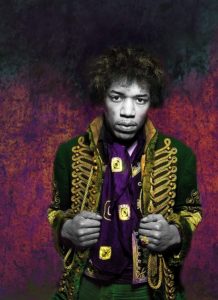
Jimi Hendrix

James Marshall “Jimi” Hendrix (born Johnny Allen Hendrix; November 27, 1942 – September 18, 1970) was an American rock guitarist, singer, and songwriter. Although his mainstream career spanned only four years, he is widely regarded as one of the most influential electric guitarists in the history of popular music, and one of the most celebrated musicians of the 20th century. The Rock and Roll Hall of Fame describes him as “arguably the greatest instrumentalist in the history of rock music”.

Born in Seattle, Washington, Hendrix began playing guitar at the age of 15. In 1961, he enlisted in the US Army and trained as a paratrooper in the 101st Airborne Division; he was granted an honorable discharge the following year. Soon afterward, he moved to Clarksville, Tennessee, and began playing gigs on the Chitlin’ Circuit, earning a place in the Isley Brothers’ backing band and later with Little Richard, with whom he continued to work through mid-1965. He then played with Curtis Knight and the Squires before moving to England in late 1966 after being discovered by Linda Keith, who in turn interested bassist Chas Chandler of the Animals in becoming his first manager. Within months, Hendrix had earned three UK top ten hits with the Jimi Hendrix Experience: “Hey Joe”, “Purple Haze”, and “The Wind Cries Mary”. He achieved fame in the US after his performance at the Monterey Pop Festival in 1967, and in 1968 his third and final studio album, Electric Ladyland, reached number one in the US; it was Hendrix’s most commercially successful release and his first and only number one album. The world’s highest-paid performer, he headlined the Woodstock Festival in 1969 and the Isle of Wight Festival in 1970 before his accidental death from barbiturate-related asphyxia on September 18, 1970, at the age of 27.

Hendrix was inspired musically by American rock and roll and electric blues. He favored overdriven amplifiers with high volume and gain, and was instrumental in utilizing the previously undesirable sounds caused by guitar amplifier feedback. He helped to popularize the use of a wah-wah pedal in mainstream rock, and was the first artist to use stereophonic phasing effects in music recordings. Holly George-Warren of Rolling Stone commented: “Hendrix pioneered the use of the instrument as an electronic sound source. Players before him had experimented with feedback and distortion, but Hendrix turned those effects and others into a controlled, fluid vocabulary every bit as personal as the blues with which he began.”

Hendrix was the recipient of several music awards during his lifetime and posthumously. In 1967, readers of Melody Maker voted him the Pop Musician of the Year, and in 1968, Rolling Stone declared him the Performer of the Year. Disc and Music Echo honored him with the World Top Musician of 1969 and in 1970, Guitar Player named him the Rock Guitarist of the Year. The Jimi Hendrix Experience was inducted into the Rock and Roll Hall of Fame in 1992 and the UK Music Hall of Fame in 2005. Rolling Stone ranked the band’s three studio albums, Are You Experienced, Axis: Bold as Love, and Electric Ladyland, among the 100 greatest albums of all time, and they ranked Hendrix as the greatest guitarist and the sixth greatest artist of all time.

Jimi Hendrix was of African-American descent. Both his mother Lucille and father Al were African-Americans. His paternal grandmother, Zenora “Nora” Rose Moore, was African-American and one-quarter Cherokee. Hendrix’s paternal grandfather, Bertran Philander Ross Hendrix (born 1866), was the result of an extramarital affair between a woman named Fanny, and a grain merchant from Urbana, Ohio or Illinois, one of the wealthiest men in the area at that time. On June 10, 1919, Hendrix and Moore had a son they named James Allen Ross Hendrix; people called him Al

In 1941, Al met Lucille Jeter (1925–1958) at a dance in Seattle; they married on March 31, 1942. Al, who had been drafted by the U.S. Army to serve in World War II, left to begin his basic training three days after the wedding. Johnny Allen Hendrix was born on November 27, 1942, in Seattle, Washington; he was the first of Lucille’s five children. In 1946, Johnny’s parents changed his name to James Marshall Hendrix, in honor of Al and his late brother Leon Marshall.

Stationed in Alabama at the time of Hendrix’s birth, Al was denied the standard military furlough afforded servicemen for childbirth; his commanding officer placed him in the stockade to prevent him from going AWOL to see his infant son in Seattle. He spent two months locked up without trial, and while in the stockade received a telegram announcing his son’s birth. During Al’s three-year absence, Lucille struggled to raise their son. When Al was away, Hendrix was mostly cared for by family members and friends, especially Lucille’s sister Delores Hall and her friend Dorothy Harding. Al received an honorable discharge from the US Army on September 1, 1945. Two months later, unable to find Lucille, Al went to the Berkeley, California home of a family friend named Mrs. Champ, who had taken care of and had attempted to adopt Hendrix; this is where Al saw his son for the first time.

After returning from service, Al reunited with Lucille, but his inability to find steady work left the family impoverished. They both struggled with alcohol, and often fought when intoxicated. The violence sometimes drove Hendrix to withdraw and hide in a closet in their home. His relationship with his brother Leon (born 1948) was close but precarious; with Leon in and out of foster care, they lived with an almost constant threat of fraternal separation. In addition to Leon, Hendrix had three younger siblings: Joseph, born in 1949, Kathy in 1950, and Pamela, 1951, all of whom Al and Lucille gave up to foster care and adoption. The family frequently moved, staying in cheap hotels and apartments around Seattle. On occasion, family members would take Hendrix to Vancouver to stay at his grandmother’s. A shy and sensitive boy, he was deeply affected by his life experiences. In later years, he confided to a girlfriend that he had been the victim of sexual abuse by a man in uniform. On December 17, 1951, when Hendrix was nine years old, his parents divorced; the court granted Al custody of him and Leon.

In September 1963, after Cox was discharged from the Army, he and Hendrix moved to Clarksville, Tennessee, and formed a band called the King Kasuals. Hendrix had watched Butch Snipes play with his teeth in Seattle and by now Alphonso ‘Baby Boo’ Young, the other guitarist in the band, was performing this guitar gimmick. Not to be upstaged, Hendrix learned to play with his teeth. He later commented: “The idea of doing that came to me…in Tennessee. Down there you have to play with your teeth or else you get shot. There’s a trail of broken teeth all over the stage.” Although they began playing low-paying gigs at obscure venues, the band eventually moved to Nashville’s Jefferson Street, which was the traditional heart of the city’s black community and home to a thriving rhythm and blues music scene. They earned a brief residency playing at a popular venue in town, the Club del Morocco, and for the next two years Hendrix made a living performing at a circuit of venues throughout the South that were affiliated with the Theater Owners’ Booking Association (TOBA), widely known as the Chitlin’ Circuit. In addition to playing in his own band, Hendrix performed as a backing musician for various soul, R&B, and blues musicians, including Wilson Pickett, Slim Harpo, Sam Cooke, and Jackie Wilson.

In January 1964, feeling he had outgrown the circuit artistically, and frustrated by having to follow the rules of bandleaders, Hendrix decided to venture out on his own. He moved into the Hotel Theresa in Harlem, where he befriended Lithofayne Pridgon, known as “Faye”, who became his girlfriend. A Harlem native with connections throughout the area’s music scene, Pridgon provided him with shelter, support, and encouragement. Hendrix also met the Allen twins, Arthur and Albert. In February 1964, Hendrix won first prize in the Apollo Theater amateur contest. Hoping to secure a career opportunity, he played the Harlem club circuit and sat in with various bands. At the recommendation of a former associate of Joe Tex, Ronnie Isley granted Hendrix an audition that led to an offer to become the guitarist with the Isley Brothers’ back-up band, the I.B. Specials, which he readily accepted.

In March 1964, Hendrix recorded the two-part single “Testify” with the Isley Brothers. Released in June, it failed to chart. In May, he provided guitar instrumentation for the Don Covay song, “Mercy Mercy”. Issued in August by Rosemart Records and distributed by Atlantic, the track reached number 35 on the Billboard chart.

Hendrix toured with the Isleys during much of 1964, but near the end of October, after growing tired of playing the same set every night, he left the band. Soon afterward, Hendrix joined Little Richard’s touring band, the Upsetters. During a stop in Los Angeles in February 1965, he recorded his first and only single with Richard, “I Don’t Know What You Got (But It’s Got Me)”, written by Don Covay and released by Vee-Jay Records. Richard’s popularity was waning at the time, and the single peaked at number 92, where it remained for one week before dropping off the chart. Hendrix met singer Rosa Lee Brooks while staying at the Wilcox Hotel in Hollywood, and she invited him to participate in a recording session for her single, which included the Arthur Lee penned “My Diary” as the A-side, and “Utee” as the B-side. Hendrix played guitar on both tracks, which also included background vocals by Lee. The single failed to chart, but Hendrix and Lee began a friendship that lasted several years; Hendrix later became an ardent supporter of Lee’s band, Love.

In July 1965, on Nashville’s Channel 5 Night Train, Hendrix made his first television appearance. Performing in Little Richard’s ensemble band, he backed up vocalists Buddy and Stacy on “Shotgun”. The video recording of the show marks the earliest known footage of Hendrix performing. Richard and Hendrix often clashed over tardiness, wardrobe, and Hendrix’s stage antics, and in late July, Richard’s brother Robert fired him. He then briefly rejoined the Isley Brothers, and recorded a second single with them, “Move Over and Let Me Dance” backed with “Have You Ever Been Disappointed”. Later that year, he joined a New York-based R&B band, Curtis Knight and the Squires, after meeting Knight in the lobby of a hotel where both men were staying. Hendrix performed with them for eight months. In October 1965, he and Knight recorded the single, “How Would You Feel” backed with “Welcome Home” and on October 15, Hendrix signed a three-year recording contract with entrepreneur Ed Chalpin. While the relationship with Chalpin was short-lived, his contract remained in force, which later caused legal and career problems for Hendrix. During his time with Knight, Hendrix briefly toured with Joey Dee and the Starliters, and worked with King Curtis on several recordings including Ray Sharpe’s two-part single, “Help Me” Hendrix earned his first composer credits for two instrumentals, “Hornets Nest” and “Knock Yourself Out”, released as a Curtis Knight and the Squires single in 1966.

Feeling restricted by his experiences as an R&B sideman, Hendrix moved to New York City’s Greenwich Village in 1966, which had a vibrant and diverse music scene. There, he was offered a residency at the Cafe Wha? on MacDougal Street and formed his own band that June, Jimmy James and the Blue Flames, which included future Spirit guitarist Randy California. The Blue Flames played at several clubs in New York and Hendrix began developing his guitar style and material that he would soon use with the Experience. In September, they gave some of their last concerts at the Cafe au Go Go, as John Hammond Jr.’s backing group

In 1966, while leading his own band in Greenwich Village in New York City, where he had attracted a small following, Hendrix was noticed by British rock musician Chas Chandler, who took him to London and introduced him to Noel Redding, a bass player, and Mitch Mitchell, a drummer.

As a trio, they formed the group called The Jimi Hendrix Experience. With this group Hendrix rapidly became popular in Europe, and his reputation preceded his return to the United States. His appearance at the Monterey International Pop Festival in 1967 was a watershed of his career, as was the success of his album “Are You Experienced?” that same year. These two events lifted him to instant rock stardom. Another album, “Electric Ladyland”(1968), was one of the most influential rock records of the 1960s.

Hendrix was an outstanding blues guitarist working in a rock idiom. The melodic lines of his extended solos were alternately ragged, soaring, or rhythmically driving, while his phrasing was augmented by the use of extremely high volume and electronic distortion. His playing had a sensuous, exotic quality that was original and instantly recognizable.

In January 1969, after an absence of more than six months, Hendrix briefly moved back into his girlfriend Kathy Etchingham’s Brook Street apartment, which was next door to the Handel House Museum in the West End of London. During this time, the Experience toured Scandinavia, Germany, and gave their final two performances in France. On February 18 and 24, they played sold-out concerts at London’s Royal Albert Hall, which were the last European appearances of this line-up.

By February 1969, Redding had grown weary of Hendrix’s unpredictable work ethic and his creative control over the Experience’s music. During the previous month’s European tour, interpersonal relations within the group had deteriorated, particularly between Hendrix and Redding. In his diary, Redding documented the building frustration during early 1969 recording sessions: “On the first day, as I nearly expected, there was nothing doing … On the second it was no show at all. I went to the pub for three hours, came back, and it was still ages before Jimi ambled in. Then we argued … On the last day, I just watched it happen for a while, and then went back to my flat.” The last Experience sessions that included Redding—a re-recording of “Stone Free” for use as a possible single release—took place on April 14 at Olmstead and the Record Plant in New York Hendrix then flew bassist Billy Cox to New York; they started recording and rehearsing together on April 21.

The last performance of the original Experience line-up took place on June 29, 1969, at Barry Fey’s Denver Pop Festival, a three-day event held at Denver’s Mile High Stadium that was marked by police using tear gas to control the audience. The band narrowly escaped from the venue in the back of a rental truck, which was partly crushed by fans who had climbed on top of the vehicle. Before the show, a journalist angered Redding by asking why he was there; the reporter then informed him that two weeks earlier Hendrix announced that he had been replaced with Billy Cox. The next day, Redding quit the Experience and returned to London. He announced that he had left the band and intended to pursue a solo career, blaming Hendrix’s plans to expand the group without allowing for his input as a primary reason for leaving. Redding later commented: “Mitch and I hung out a lot together, but we’re English. If we’d go out, Jimi would stay in his room. But any bad feelings came from us being three guys who were traveling too hard, getting too tired, and taking too many drugs … I liked Hendrix. I don’t like Mitchell.”

Soon after Redding’s departure, Hendrix began lodging at the eight-bedroom Ashokan House, in the hamlet of Boiceville near Woodstock in upstate New York, where he had spent some time vacationing in mid-1969. Manager Michael Jeffery arranged the accommodations in the hope that the respite might encourage Hendrix to write material for a new album. During this time, Mitchell was unavailable for commitments made by Jeffery, which included Hendrix’s first appearance on U.S. TV—on The Dick Cavett Show—where he was backed by the studio orchestra, and an appearance on The Tonight Show where he appeared with Cox and session drummer Ed Shaughnessy.

By 1969, Hendrix was the world’s highest-paid rock musician. In August, he headlined the Woodstock Music and Art Fair that included many of the most popular bands of the time. For the concert, he added rhythm guitarist Larry Lee and conga players Juma Sultan and Jerry Velez. The band rehearsed for less than two weeks before the performance, and according to Mitchell, they never connected musically. Before arriving at the engagement, he heard reports that the size of the audience had grown to epic proportions, which gave him cause for concern as he did not enjoy performing for large crowds. He was an important draw for the event, and although he accepted substantially less money for the appearance than his usual fee, he was the festival’s highest-paid performer. As his scheduled time slot of midnight on Sunday drew closer, he indicated that he preferred to wait and close the show in the morning; the band took the stage around 8:00 a.m. on Monday. By the time of their set, Hendrix had been awake for more than three days. The audience, which peaked at an estimated 400,000 people, was now reduced to 30–40,000, many of whom had waited to catch a glimpse of Hendrix before leaving during his performance. The festival MC, Chip Monck, introduced the group as the Jimi Hendrix Experience, but Hendrix clarified: “We decided to change the whole thing around and call it Gypsy Sun and Rainbows. For short, it’s nothin’ but a Band of Gypsys”.

Hendrix’s performance featured a rendition of the U.S. national anthem, “The Star-Spangled Banner”, during which he used copious amounts of amplifier feedback, distortion, and sustain to replicate the sounds made by rockets and bombs. Although contemporary political pundits described his interpretation as a statement against the Vietnam War, three weeks later Hendrix explained its meaning: “We’re all Americans … it was like ‘Go America!’… We play it the way the air is in America today. The air is slightly static, see”. Immortalized in the 1970 documentary film, Woodstock, his guitar-driven version would become part of the sixties Zeitgeist. Pop critic Al Aronowitz of The New York Post wrote: “It was the most electrifying moment of Woodstock, and it was probably the single greatest moment of the sixties.” Images of the performance showing Hendrix wearing a blue-beaded white leather jacket with fringe, a red head-scarf, and blue jeans are widely regarded as iconic pictures that capture a defining moment of the era. He played “Hey Joe” during the encore, concluding the 3½-day festival. Upon leaving the stage, he collapsed from exhaustion. In 2011, the editors of Guitar World placed his rendition of “The Star-Spangled Banner” at Woodstock at number one in their list of his 100 greatest performances.

Although the details of Hendrix’s last day and death are widely disputed, he spent much of September 17, 1970, in London with Monika Dannemann, the only witness to his final hours. Dannemann said that she prepared a meal for them at her apartment in the Samarkand Hotel, 22 Lansdowne Crescent, Notting Hill, sometime around 11 p.m., when they shared a bottle of wine. She drove Hendrix to the residence of an acquaintance at approximately 1:45 a.m., where he remained for about an hour before she picked him up and drove them back to her flat at 3 a.m. Dannemann said they talked until around 7 a.m., when they went to sleep. She awoke around 11 a.m., and found Hendrix breathing, but unconscious and unresponsive. She called for an ambulance at 11:18 a.m., which arrived on the scene at 11:27 a.m. Paramedics then transported Hendrix to St Mary Abbot’s Hospital where Dr. John Bannister pronounced him dead at 12:45 p.m. on September 18, 1970.

To determine the cause of death, coroner Gavin Thurston ordered a post-mortem examination on Hendrix’s body, which was performed on September 21 by Professor Robert Donald Teare, a forensic pathologist. Thurston completed the inquest on September 28, and concluded that Hendrix aspirated his own vomit and died of asphyxia while intoxicated with barbiturates. Citing “insufficient evidence of the circumstances”, he declared an open verdict. Dannemann later revealed that Hendrix had taken nine of her prescribed Vesparax sleeping tablets, 18 times the recommended dosage.

After Hendrix’s body had been embalmed by Desmond Henley, it was flown to Seattle, Washington, on September 29, 1970. After a service at Dunlop Baptist Church on October 1, it was interred at Greenwood Cemetery in Renton, Washington, the location of his mother’s gravesite. Hendrix’s family and friends traveled in twenty-four limousines and more than two hundred people attended the funeral, including several notable musicians such as original Experience members Mitch Mitchell and Noel Redding, as well as Miles Davis, John Hammond, and Johnny Winter.

Written by Dianne Washington street line

Tina Turner

Tina Turner was born on this date in 1939. She is an African American singer, dancer, and entertainer.

Born Anna Mae Bullock, near Brownsville, TN, she began singing as a teen and joined Ike Turner’s touring show as an 18-year-old backup vocalist. Just two years later, she was the star of the show, the attention-grabbing focal point for an incredibly smooth-running soul revue headed by Ike and his Kings of Rhythm. The couple began hitting the charts in 1960 with “A Fool in Love,” and notched charting singles throughout the 1960s such as “River Deep-Mountain High” and in 1971 with “Proud Mary.”

Frustrated by Ike’s increasingly irrational behavior, though, Tina walked out just three years later. Turner converted to Buddhism in 1974 to help her conquer her troubling marriage to Ike Turner. Turner has credited Buddhism with giving her the courage to leave Ike and to find peace. Since then she has been acknowledged as one of the world’s most popular entertainers, biggest-selling music artists of all time, and the most successful female rock artist ever. She had record sales of nearly 200 million copies worldwide and sold more concert tickets than any other solo performer in music’s history.

After leaving Ike Turner in 1976, and divorcing him in 1978, Turner didn’t get into a serious relationship again until she met a German record executive named Erwin Bach while at Heathrow Airport in London in 1985. After a year, they started dating and have been living together ever since. Bach is 17 years younger than Turner.

Turner’s world tour Break Every Rule Tour had record- breaking ticket sales and was attended by over 4 million fans. Turner also beat out The Rolling Stones by touring Europe during her sold out Foreign Affair Tour in 1990 and playing to 4 million people in just six months. Her 1996 Wildest Dreams Tour was performed to 3.5 million fans.

In 2000, she launched her Twenty Four Seven Tour that packed stadiums all over the world. It was the highest grossing tour of the year, and is the 5th biggest grossing tour in America ever. Her success and contributions to the rock music genre have garnered her title, “The Queen of Rock & Roll.”

She is known for her overpowering and energetic stage presence, powerful vocals, ground-breaking concerts. She was listed on Rolling Stone’s list, “The Immortals: The Greatest Artists of All Time.” Turner is a Rock and Roll Hall of Fame inductee, and she is also represented in the Grammy Hall of Fame by two of her recordings: “River Deep – Mountain High” (1999) and “Proud Mary” (2003).

Turner has won eight Grammy Awards. In February 2008, at age 68, Turner performed together with Beyoncé at the 50th Annual Grammy Awards. In addition, she picked up a Grammy as a featured artist on River: The Joni Letters. On April 29, 2008, Turner announced that she would embark on her Tina: Live in Concert Tour on October 1 in Kansas City, MO, at the Sprint Center. Turner is the mother of two sons and adopted Ike Turner’s two children from other relationships.

Turner has lived in Europe since the mid-1980s, having moved to London in 1986 before settling in Switzerland later that decade. In 1996, she began building a villa outside Nice, France, which was completed by 2000. Turner now divides her time between Switzerland, England, and France and has recently applied for full Swiss citizenship.

Written by Dianne Washington

Larry Davis

On November 19, 30 years ago Larry Davis defended himself from a NYPD Hit Squad of over 25 officers.

Larry Davis (May 28, 1966 – February 20, 2008), who changed his name to Adam Abdul-Hakeem in 1989, was a New Yorker who shot six New York City Police Department officers on November 19, 1986, when they raided his sister’s apartment in the Bronx. The police said that the raid was executed in order to question Davis about the killing of four suspected drug dealers.

At trial, Davis’s defense attorneys, including William Kunstler, claimed that the raid was staged to murder him because of his knowledge of the involvement of corrupt police in the drug business. With the help of family contacts and friends, he eluded capture for the next 17 days despite a massive manhunt. Once the search was narrowed to a single building, he took several hostages but surrendered to police when the presence of reporters convinced him he would not be harmed.

Davis was acquitted of attempted murder charges in the police shootout case and also acquitted of murder charges in the case involving the slain drug dealers. He was found guilty of weapons possession in the shootout case, acquitted in another murder case, and was found guilty in a later murder case, for which he was sentenced to 25 years to life in prison. In 2008, Davis was stabbed to death in a fight with another inmate.

The Davis case generated controversy. Many were outraged by his actions and acquittal, but others regarded him as a folk hero for his ability to elude capture in the massive manhunt, or as the embodiment of a community’s frustration with the police, or as “a symbol of resistance” because “he fought back for African-Americans who are being killed by white police officers.”

Written by Dianne Washington

Robin Roberts

Robin René Roberts (born November 23, 1960) is an American television broadcaster. Roberts is the anchor of ABC’s Good Morning America.

After growing up in Mississippi and attending Southeastern Louisiana University, Roberts was a sports anchor for local TV and radio stations. Roberts was a sportscaster on ESPN for 15 years (1990–2005). She became co-anchor on Good Morning America in 2005. She has been treated for breast cancer and for myelodysplastic syndrome.

After growing up in Mississippi and attending Southeastern Louisiana University, Roberts was a sports anchor for local TV and radio stations. Roberts was a sportscaster on ESPN for 15 years (1990–2005). She became co-anchor on Good Morning America in 2005. She has been treated for breast cancer and for myelodysplastic syndrome.

Though born in Tuskegee, Alabama, Robin Roberts grew up in Pass Christian, Mississippi, where she played basketball and tennis, among other sports. She attended Pass Christian High School and graduated as the class of 1979 salutatorian. She is the daughter of Lucimarian (née Tolliver) and Colonel Lawrence E. Roberts.

In a 2006 presentation to the assembled student body at Abilene Christian University, Roberts credited her parents as cultivating the “three ‘D’s: Discipline, Determination, and ‘De Lord’.” She is the youngest of four, following siblings Sally-Ann, Lawrence, Jr. (nicknamed Butch), and Dorothy. Her father was a pilot with the Tuskegee Airmen.

Roberts attended Southeastern Louisiana University in Hammond, Louisiana, graduating cum laude in 1983 with a degree in communication. She followed in the footsteps of her older sister Sally-Ann Roberts, an anchor at the CBS affiliate WWL-TV in New Orleans.

Roberts noted on the January 13, 2007, edition of Costas on the Radio that she was offered a scholarship to play basketball at Louisiana State University but thought the school was too big and impersonal after visiting the campus. On her way back to Pass Christian from that visit, she saw a road sign for Southeastern Louisiana University, stopped to visit and decided to enroll. The only scholarship left was a tennis scholarship, and she was promised that there would be a journalism scholarship by the time she would graduate. She went on to become a standout performer on the women’s basketball team, ending her career as the school’s third all-time leading scorer (1,446 points) and rebounder (1,034). Roberts is one of only three Lady Lions to score 1,000 career points and grab 1,000 career rebounds. During her senior season, she averaged a career-high 15.2 points per game. On February 5, 2011, Southeastern hosted a ceremony to retire Roberts’ jersey, number 21.

Roberts began her career in 1983 as a sports anchor and reporter for WDAM-TV in Hattiesburg, Mississippi. In 1984, she moved to WLOX-TV in Biloxi, Mississippi. In 1986, she was sports anchor and reporter for WSMV-TV in Nashville, Tennessee. She was also a sports anchor and reporter at WAGA-TV in Atlanta, Georgia, from 1988 to 1990. She was also a radio host for radio station V-103 while in Atlanta.

She joined ESPN as a sportscaster in February 1990, where she stayed until 2005. She became well known on SportsCenter for her catchphrase, “Go on with your bad self!” Roberts began to work for ABC News, specifically as a featured reporter, for Good Morning America in June 1995. In 2001, Roberts received the Mel Greenberg Media Award, presented by the WBCA.

For many years, Roberts worked at both ESPN and Good Morning America, contributing to both programs. During that time, she served primarily as the news anchor at GMA. In 2005, Roberts was promoted to co-anchor of Good Morning America. In December 2009, Roberts was joined by George Stephanopoulos as co-anchor of GMA after Diane Sawyer left to anchor ABC World News. Under their partnership, the Roberts-Stephanopoulos team led Good Morning America back to the top of the ratings; the program became the number-one morning show again in April 2012, beating NBC’s Today, which had held the top spot for the previous 16 years.

In the fall of 2005, Roberts anchored a series of emotional reports from the Mississippi Gulf Coast after it was devastated by Hurricane Katrina; her hometown of Pass Christian was especially hard hit, with her old high school reduced to rubble. On February 22, 2009, Roberts hosted the Academy Awards preshow for ABC, and did so again in 2011. In 2010, Roberts guest starred on Disney Channel’s Hannah Montana, appearing in season 4, episode 10, “Can You See the Real Me?” On May 30, 2010, Roberts drove the Pace Car for the 2010 Indianapolis 500.

Roberts was inducted into the Women’s Basketball Hall of Fame as part of the Hall’s class of 2012 for her contributions to and impact on the game of women’s basketball through her broadcasting work and play. In 2014 Roberts was named one of ESPNW’s Impact 25.

Roberts is a practicing Christian. In 2007, Roberts was diagnosed with an early form of breast cancer. She underwent surgery on August 3, and by January 2008 had completed eight chemotherapy treatments, followed by 6½ weeks of radiation treatment.

In 2012, she was diagnosed with myelodysplastic syndrome (MDS), a disease of the bone marrow. Be the Match Registry, a nonprofit organization run by the National Marrow Donor Program, experienced an 1,800% spike in donors the day Roberts went public with her illness. She took a leave from GMA to get a bone marrow transplant, and went home in October 2012. She returned to GMA on February 20, 2013. Roberts received a 2012 Peabody Award for the program. The Peabody citation credits her for “allowing her network to document and build a public service campaign around her battle with rare disease” and “inspir[ing] hundreds of potential bone marrow donors to register and heighten[ing] awareness of the need for even more donors.” ESPN awarded its Arthur Ashe Courage Award to Robin Roberts at the 2013 ESPYs.

On December 29, 2013, Roberts posted a photo on Facebook with a caption that read:

“At this moment I am at peace and filled with joy and gratitude. I am grateful to God, my doctors and nurses for my restored good health… I am grateful for my entire family, my long time girlfriend, Amber, and friends as we prepare to celebrate a glorious new year together.”

The post was a reflection of the past year and noted her health, the status of her bone marrow transplant, and her sexual orientation. Roberts and Amber Laign, a massage therapist, have been together since 2005. Though friends and co-workers have known about her same-sex relationships, this was the first time Roberts publicly acknowledged her sexual orientation. In 2015, she was named as one of the 31 Icons of 2015’s LGBT History Month by Equality Forum.

Written by Dianne Washington

Gene Anthony Ray

Gene Anthony Ray (May 24, 1962 – November 14, 2003) was an American actor, dancer, and choreographer. He was known for his portrayal of dancer Leroy Johnson in both the 1980 film Fame and the 1982–1987 Fame television series based upon the film.

Born in Harlem, New York, on May 24, 1962, Ray grew up in the neighborhood of West 153rd Street. He began performing early in life, street dancing at block parties. He performed in a dance class at the Julia Richman High School; he skipped school one day to audition for Fame choreographer, Louis Falco.

Ray attended the New York High School of the Performing Arts, the inspiration for the film Fame, but was kicked out after one year. “It was too disciplined for this wild child of mine,” Ray’s mother, Jean E. Ray, said.

Ray won the part of Leroy Johnson in the film Fame, which was released in 1980. Much like his Fame character, Ray had little professional training, but he possessed a raw talent that won him his role for the film. Reports USA Today: “Alan (Parker, the director) had to approach him very carefully. His mom was dealing drugs during the filming. It was not pretty.”

In 1981, Ray starred as Friday, alongside Michael York as Robinson Crusoe, in the 1981 TV adventure-comedy Vendredi ou la Vie sauvage [fr] (alternative title: Robinson Crusoe and Man Friday).

Ray also starred in television series based on the film, Fame. The series was produced by MGM Television from 1982 to 1987, and syndicated from 1983 to 1987.

Also in 1982, Ray danced in The Weather Girls’ music video for “Well-A-Wiggy”. Additionally, he began touring the U.K. with the other members of the Fame cast as The Kids from “Fame”; they performed at 10 venues, including a sell out performance at Royal Albert Hall.

In 1984, USA Today reports: “Ray was axed from the show after his mother was jailed for running a drug ring, and he failed to turn up for work 100 times.” He struggled with addictions to alcohol and drugs, and worked only intermittently once the TV series ended.

In 1987, he won the role of Billy Nolan in the ill-fated musical adaptation of Carrie by Stephen King. Ray played the role in the original opening in Stratford-Upon-Avon, which closed after less than a month. He then transferred to Broadway and continued to play the role until the musical closed after only 21 public performances.

Ray also appeared in the 1995 film Out-of-Sync, which was directed by his Fame co-star Debbie Allen, in the 1996 Whoopi Goldberg comedy Eddie (for which he was also credited as associate choreographer), as well as in commercials for Dr Pepper and Diet Coke.

His last video project was a one-hour BBC Fame reunion documentary, Fame Remember My Name, taped in Los Angeles in April 2003.

As his Telegraph obituary describes:

“Ray remained a ‘frantic partygoer’ with a self-confessed weakness for drink and drugs. As his life fell apart, he slept on park benches, and during a failed attempt to launch a Fame-style dance school in Milan, shared a flat there with a porn actress. In 1996 he was diagnosed HIV positive. He suffered a stroke in 2003.

“Flamboyantly camp, he brushed aside questions about his sexuality. He never married.”

In 2001, Marco Papa, an Italian artist, tried to trace Gene Anthony Ray to involve him in his art project Dancing on the Verge, a research between success and failure. The result of their professional and human relationship was documented by drawings, sculptures, installations video and multimedia performances, and collected in the book entitled Dancing on the Verge, published by Charta, which testifies to their path until the death of Ray.

Written by Dianne Washington

Delroy Lindo

Delroy George Lindo (born November 18, 1952) is an English actor and theatre director. Lindo has been nominated for the Tony and Screen Actors Guild awards and has won a Satellite Award. He is perhaps best known for his roles in a trio of Spike Lee films, especially as West Indian Archie in Lee’s Malcolm X (1992) and Woody Carmichael in Crooklyn (1994), Catlett in Get Shorty, Arthur Rose in The Cider House Rules, and Detective Castlebeck in Gone in 60 Seconds (2000). Lindo starred as Alderman Ronin Gibbons in the TV series The Chicago Code (2011), and as Winter on the series Believe, which premiered in 2014.

Delroy Lindo was born in 1952 in Eltham, south-east London, the son of Jamaican parents who had migrated to England. He was brought up in nearby Lewisham and got interested in acting as a child in a Nativity play. His mother was a nurse and his father worked in various jobs. As a teenager, he and his mother moved to Toronto, Canada. When he was sixteen, they moved to San Francisco. At the age of 24, Lindo started acting studies at the American Conservatory Theater, graduating in 1979.

Lindo’s movie debut came in 1976 with the British comedy Find The Lady, followed by two other roles in films, including an Army Sergeant in More American Graffiti (1979).

He quit film for 10 years to concentrate on theatre acting. In 1982 he debuted on Broadway in “Master Harold”…and the Boys, directed by the play’s South African author Athol Fugard. By 1988 Lindo had earned a Tony nomination for his portrayal of Herald Loomis in August Wilson’s Joe Turner’s Come and Gone.

Lindo returned to film in the 1990s, acting alongside Rutger Hauer and Joan Chen in the cult science fiction movie Salute of the Jugger (1990), which has become a cult classic. Although he had turned down Spike Lee for a role in his debut Do the Right Thing, Lee cast him as Woody Carmichael in the drama Crooklyn (1994), which brought him notice. Together with his other roles with Lee – as the West Indian Archie, a psychotic gangster, in Malcolm X, and a starring role as a neighbourhood drug dealer in Clockers – he became established in his film career.

Other films in which he has starring roles are Barry Sonnenfeld’s Get Shorty (1995), Ron Howard’s Ransom (1996), and Soul of the Game (1996), as the baseball player Satchel Paige. As a character actor, Lindo has readily taken on roles as treacherous bad guys as well as those of trustworthy professionals.

In 1998 Lindo co-starred as African-American explorer Matthew Henson, in the TV movie Glory & Honor, directed by Kevin Hooks. It portrayed his nearly 20-year partnership with Commander Robert Peary in Arctic exploration and their effort to find the Geographic North Pole in 1909. He received a Satellite Award as best actor. Lindo continues to work in television and was most recently seen on the short-lived NBC drama Kidnapped.

Lindo played an angel in the comedy film A Life Less Ordinary (1997), in which Dan Hedaya played the angel Gabriel, and Lindo’s boss. He guest-starred on The Simpsons in the episode “Brawl in the Family”, playing a similar character named Gabriel.

Lindo had a small role in the 1995 science fiction/action film Congo, playing the corrupt Captain Wanta. Lindo was not credited for the role, but one of his lines in the film, “Stop eating my sesame cake!”, has become an internet meme.

In the British film, Wondrous Oblivion (2003), directed by Paul Morrison, he starred as Dennis Samuels, the father of a Jamaican immigrant family in London in the 1950s; he coaches his children and the son of a neighbour Jewish family in cricket, earning their admiration in a time of strained social relations. Lindo said he made the film in honor of his parents, who had similarly moved to London in those years.

In 2007, Lindo began an association with Berkeley Repertory Theatre in Berkeley, California, when he directed Tanya Barfield’s play The Blue Door. In the fall of 2008, Lindo revisited August Wilson’s play, Joe Turner’s Come and Gone, directing a production at the Berkeley Rep. In 2010, he played the role of elderly seer Bynum in David Lan’s production of Joe Turner at the Young Vic Theatre in London.

Lindo is poised to play Marcus Garvey in an upcoming biopic of the black nationalist historical figure.

Written by Dianne Washington

Ol’ Dirty Bastard

SHIMMY, SHIMMY YO SHIMMY YAM SHIMMY YE, GIVE ME THE MIC SO I CAN TAKE Y’ALL AWAY! OL DIRTY BASTARD Y’ALL! MOMMASHIP CERTIFIED AND COMPLETELY UNFUCKWITABLE!

Russell Tyrone Jones (November 15, 1968 – November 13, 2004), better known under his stage name Ol’ Dirty Bastard (or ODB), was an American rapper and producer. He was one of the founding members of the Wu-Tang Clan, a rap group primarily from Staten Island, New York which first rose to mainstream prominence with their 1993 debut album Enter the Wu-Tang (36 Chambers).

After establishing the Wu-Tang Clan, Ol’ Dirty Bastard went on to pursue a successful solo career and contributed as a rapper/producer for the Fugees. However, his professional success was hampered by frequent legal troubles, including incarceration. He died on November 13, 2004, of a drug overdose, two days before his 36th birthday. Before his death, Ol’ Dirty Bastard recorded his third solo album, which remains unreleased.

Ol’ Dirty Bastard was noted for his “outrageously profane, free-associative rhymes delivered in a distinctive half-rapped, half-sung style”. His stage name was derived from the 1980 martial arts film Ol’ Dirty and the Bastard (also called An Old Kung Fu Master, starring Yuen Siu-tien).

Russell Jones was born on November 15, 1968 in the Fort Greene section of Brooklyn, New York. He and his cousins Robert Diggs and Gary Grice shared a taste for rap music and martial arts-style movies. Jones, Diggs, and Grice (later known as Ol’ Dirty Bastard, RZA, and GZA respectively) formed the group Force of the Imperial Master, which subsequently became known as All in Together Now after their successful underground single of the same name. They eventually added six more members to their group, calling it the Wu-Tang Clan. The group released their debut album Enter the Wu-Tang (36 Chambers) in 1993, receiving notable commercial and critical success.

Leading up to his death, Ol’ Dirty Bastard’s legal troubles and eccentric behavior made him “something of a folk hero”, according to The New Yorker writer Michael Agger. Music writer Steve Huey wrote: “it was difficult for observers to tell whether Ol’ Dirty Bastard’s wildly erratic behavior was the result of serious drug problems or genuine mental instability.” According to The Atlantic contributing editor and music biographer James Parker, ODB had been diagnosed with schizophrenia in 2003.

Ol’ Dirty Bastard collapsed at approximately 4:35 pm (EST) on November 13, 2004 (two days before his 36th birthday) at RZA’s recording studio (36 Chambers Records LLC on West 34th Street in New York City). His funeral was held at Brooklyn’s Christian Cultural Center and drew a crowd of thousands.

The official cause of death was a drug overdose; an autopsy found a lethal mixture of cocaine and the prescription drug tramadol. The overdose was ruled accidental and witnesses say Ol’ Dirty Bastard complained of chest pain on the day he died.